FreeYour CMSAbout 60 min
Expand Thin Content
Build out shallow pages so they fully answer the topic. A thin page leaves the reader with questions, so they go back to Google. Deep means complete. It doesn't mean long for the sake of it.
Why This Matters
Google tends to favor the most complete, helpful answer. If the top results cover more than you, matching their depth closes the gap. Padding won't help, and the wrong kind of filler can make a good page worse.
✓ How To Do It
- Compare your page to the top 3 ranking pages from the audit.
- Add the sub-topics, questions, and detail they cover that you don't.
- Answer the 'People also ask' questions for the keyword.
- Put a short, direct answer right under each heading, then explain. Clear answers are easier for AI Overviews, AI Mode, ChatGPT, and Perplexity to quote and cite.
- Add what only you can say. Real prices, real jobs, photos from your own work and common mistakes you see.
- Keep it truly useful. Add depth, not padding.
Done WhenEach thin target page now covers what the top 3 results cover, with a direct answer under each heading.
Tools For This StepGoogle Search Console
From the field. Supercanic, Hemet, CA
Our service pages follow one shape we call bite, snack, meal. The bite is one sentence that answers the question with a real number, like brake jobs at $125 to $150 per axle in labor. The snack is a four point At a Glance box. The meal is the full page with prices, photos and an FAQ. A reader in a hurry gets the answer, and so does an AI tool looking for a quote.
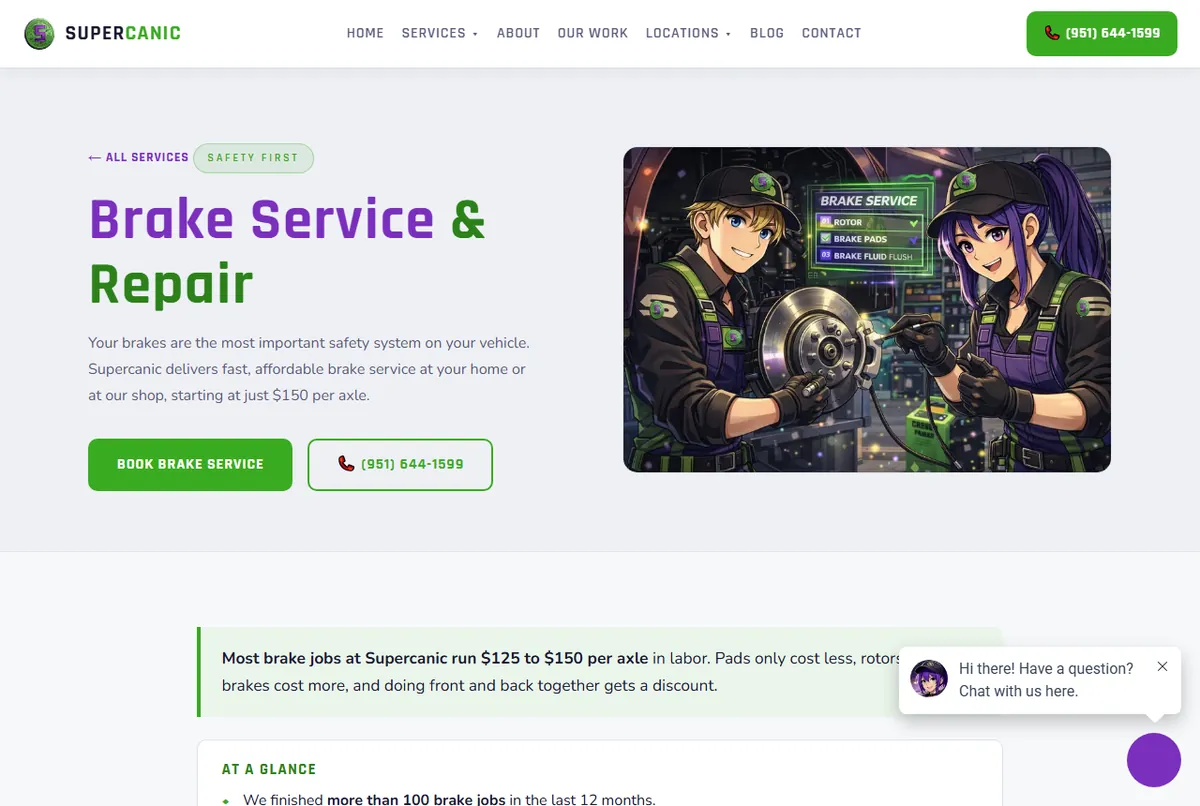

▶ Brake Service and Repair in Hemet and Riverside County
Tips & Pitfalls
- Start with pages that already get impressions. They give you results faster than pages nobody sees.
- Don't publish AI text without checking it. Every fact on the page is yours to stand behind.
- Check your phone view after adding text. Long blocks need short paragraphs, lists and clear headings to stay readable.
Email Me The Free Course
Get your course link in your inbox so you can pick it up on any device. It's free, with no card.